Star Citizen Ship Equipment Guide (2026)
What every component does, how grades trade performance against radar detectability, and how to swap parts at a ship terminal.
Every ship in Star Citizen is made up of interchangeable parts. The stock components that come with a ship are fine to start with, but swapping them out lets you tune the ship for combat, stealth, cargo hauling, or long-range exploration. This guide covers what each component type does and which choices matter most for new players.
Power plants
The power plant generates electricity for everything else on your ship — weapons, shields, engines, and all other systems. If your power plant cannot supply enough electricity, some systems will throttle down or shut off.
Components come in three grades. Grade determines the trade-off between raw power output and how easily enemy scanners can detect you:
- Grade A: Highest power output. Runs all weapons, shields, and engines simultaneously at peak. Emits a strong EM (electromagnetic) signal — easier to detect on radar. Best for combat.
- Grade B: Balanced power and EM signal. This is the default on most ships as they come from the manufacturer.
- Grade C: Lowest power output and the lowest EM signal. Used in stealth builds where staying off radar matters more than peak performance.
Coolers
Running your ship at full power generates heat. The cooler dissipates that heat. If heat builds up faster than the cooler can handle it, components start throttling or shutting down.
- Industrial cooler: High cooling capacity at the cost of higher power draw. For ships that run hot under sustained fire.
- Stealth cooler: Lower cooling capacity but minimal IR (infrared) signal. Pairs with Grade C power plants for stealth builds.
- Performance cooler: A balance of cooling and power draw. Good default for most non-stealth ships.
Quantum drives
The quantum drive powers quantum travel — the faster-than-light mode you use to cross large distances between planets and stations. Two stats matter most: spool time (how long before you can jump) and fuel efficiency (how far per tank).
- Military drive: Fastest spool time. Best for quick escapes or routes where combat is likely.
- Civilian drive: Balanced spool time and fuel efficiency. Good all-purpose choice.
- Industrial drive: Slowest spool but highest fuel efficiency. Best for long-haul cargo runs or deep exploration.
Shields
Shields protect your hull from damage. Most ships have a multi-face shield — you can reinforce specific sides (front, rear, left, right) by redirecting shield power through the shield management display in the cockpit. Smaller ships often have a single-face shield that distributes protection evenly.
- Military shields: Highest total hit points, slower recharge rate. Good for absorbing sustained fire in a prolonged fight.
- Civilian shields: Balanced hit points and recharge. Solid default for most roles.
- Stealth shields: Lower hit points but faster recharge and minimal EM output. Pairs with stealth builds.
Ship weapons
Ship weapons fall into two categories. The choice between them depends on whether you are trying to destroy shields quickly or punch through to the hull underneath.
Ballistic weapons
- Use physical ammunition. You will run out eventually during a long fight.
- Partially bypass shields — they deal some direct hull damage even through an active shield.
- Higher damage per hit than equivalent energy weapons.
Energy weapons
- Use power from the ship's power plant. No ammunition to run out of.
- Must fully deplete shields before dealing hull damage.
- High shield damage per second — excellent for stripping shields quickly.
- Generate heat during sustained fire, which stresses your cooler.
The power triangle
In the cockpit, you have access to a power distribution display — often called the power triangle. It lets you redirect power between three systems during flight:
- Weapons: More power increases fire rate and charge speed for energy weapons.
- Shields: More power speeds up how fast your shields recharge.
- Engines: More power increases your top speed.
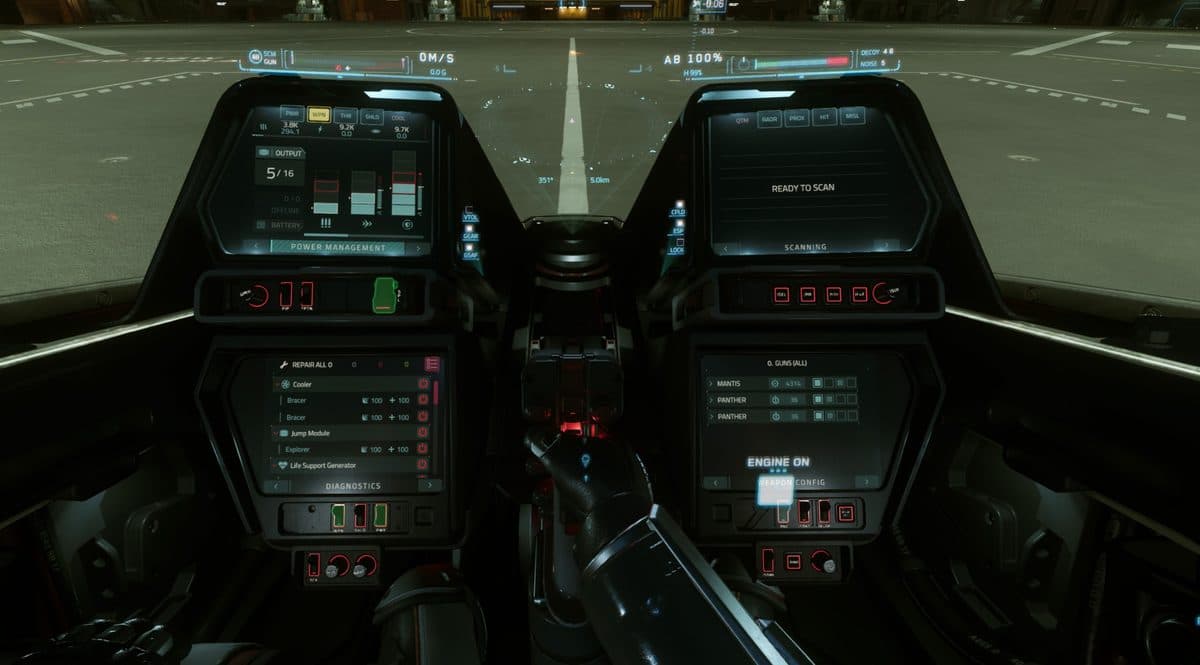
Shifting power dynamically during a fight gives experienced pilots an edge. When chasing an enemy, push power to engines. When being fired on, push it to shields. When you have a clear shot, push it to weapons.
How to swap ship components
- Buy replacement components at an equipment shop. Dumper's Depot (most orbital stations) is the easiest to reach. Omega Pro in New Babbage and Apocalypse Arms in Area18 have better selection.
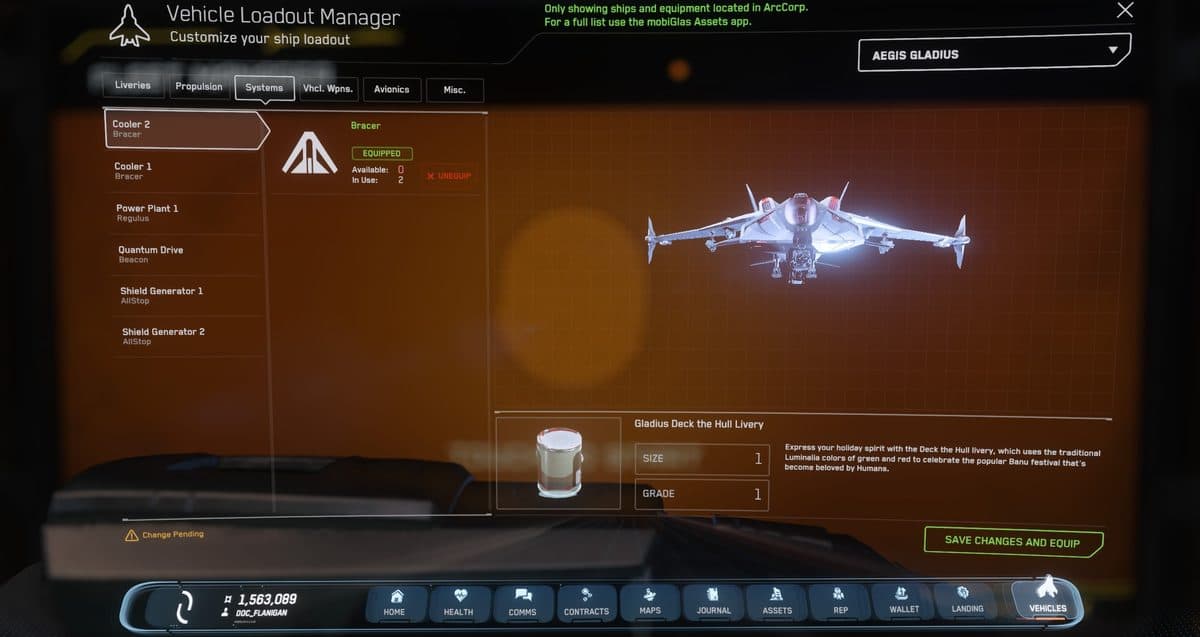
- Go to an ASOP terminal in a spaceport or access the ship's loadout panel while on board.
- Open the loadout screen and drag the new component into the correct slot.
- Confirm the change. Components must match the size rating of the slot they go in — you cannot put a size three component in a size one slot.
Common questions
What is the best component setup for combat?
For combat: Grade A power plant (runs everything at full power), military shields (maximum hit points), and a performance cooler. Energy weapons scale well with a Grade A plant — they never run out of ammo and deal high shield damage. Test your full loadout in Arena Commander before committing to it in the Persistent Universe.
Do component grades affect whether enemies can detect me?
Yes. Grade A power plants have the highest EM signal, making you easier to spot on radar. Grade C components minimize your EM and IR output. Running at full throttle or firing weapons continuously spikes your IR signature regardless of component grade — for true stealth you also need to manage your throttle and fire rate.
Should I use ballistic or energy weapons?
Energy weapons are better at stripping shields quickly. Ballistic weapons bypass shields partially and are better if you need to deal hull damage. Many experienced pilots mix the two — energy weapons for shields, ballistics for the hull once shields are down. Ammo management for ballistics is an extra consideration on longer missions.
Not signed up yet? Use a referral code and start with fifty thousand bonus credits — enough for your first component upgrades.
Get your 50K UEC bonus